
Why Brownies Are Better Than Cake for Delivery (And Why It Matters for Gifting)
|
|
Time to read 10 min
|
|
Time to read 10 min
Not all brownies are suited to delivery. While cakes can be delicate and affected by movement or temperature, brownies with a balanced, chocolate-led structure tend to hold their shape and texture more reliably during transport.This is why brownies are often considered better for delivery, particularly when sending gifts across Australia where consistency and structure matter.
The brownies that travel best sit between cakey and overly soft styles. This balance allows them to remain cohesive, resist crumbling, and deliver a consistent eating experience after delivery.
When it comes to sending a thoughtful gift, the question is no longer just what feels indulgent or celebratory — it’s what will arrive in the same condition it was sent.
For many years, cakes have been the traditional choice for gifting. They signal occasion, generosity, and shared moments. But as gifting has evolved — particularly with delivery across cities and countries — the limitations of certain formats have become more visible.
Not all desserts are designed to travel.
And this is where brownies, particularly those developed with both chocolate and baking principles in mind, offer a distinctly different advantage.
To understand how this works in practice, you can explore our → Brownie Delivery Australia page, where we outline how brownies are designed to travel reliably and arrive in excellent condition.
Cakes are, by nature, delicate.
They are typically built with:
These elements create visual appeal but introduce fragility.
During delivery, cakes are vulnerable to:
Even with careful packaging, cakes depend heavily on controlled conditions.
Brownies operate differently.
Rather than relying on air and height, brownies are grounded in:
This creates a product that is inherently more stable — not because it is protected from movement, but because it is less affected by it.
One of the most common assumptions is that all brownies behave the same way during delivery.
In reality, the category varies significantly.
Some brownies are:
While these styles may work well for immediate consumption, they are often less suited to transport. A drier, more aerated brownie can:
At the other end of the spectrum, very soft or under-structured brownies can also present challenges. Products that are overly molten or delicate may:
This variation is important. It highlights that delivery performance is not simply about choosing brownies over cake — it depends on how the brownie itself is made.
Brownies that travel well are typically those developed with both structure and richness in mind.
A formulation that balances:
creates a product that is:
In particular, brownies that incorporate real chocolate — rather than relying primarily on cocoa powder — tend to develop a more unified structure.
This allows them to:
One of the most important — and often overlooked — factors in delivery performance is formulation.
Historically, many brownies relied heavily on cocoa powder, resulting in a drier, more crumbly texture. While suitable for immediate consumption, this type of structure is less forgiving during transport.
A shift occurs when real chocolate is introduced more prominently into the formulation.
Chocolate contributes:
When brownies are developed as a balance between chocolate and traditional brownie structure — rather than purely cocoa-based — the result is a product that behaves differently in transit.
It becomes:
This is one of the key reasons certain brownies are more suited to delivery than others.
A useful way to understand delivery performance is to think of brownies not as a single category, but as a spectrum.
At one end:
At the other:
Between these sits a more balanced structure — a hybrid approach that combines:
This hybrid style creates a brownie that is:
From a delivery perspective, this balance is critical.
Products that are too soft may deform.
Products that are too dry may crumble.
A balanced formulation allows brownies to:
In baking, even minor adjustments to formulation can significantly affect how a product behaves over time.
Variations in:
can shift a brownie from being stable and cohesive to fragile or inconsistent.
This is particularly relevant for delivery. A formulation that performs well straight from the oven may not necessarily hold its structure after hours — or days — in transit.
Brownies developed with delivery in mind tend to account for this, balancing richness with structural integrity so that the product remains consistent beyond the moment it is made.
In controlled environments, many products perform well.
But delivery introduces variables:
A product’s ability to withstand these conditions depends on how it is built.
Brownies with a stable, chocolate-led structure:
This is why many people now look toward options like brownie delivery across Australia
when sending gifts that need to travel beyond immediate reach.
Another critical factor in delivery is shelf life.
Cakes — particularly those with fresh fillings — often require:
Brownies, when properly formulated, offer a longer shelf life.
This is not simply a convenience — it is directly linked to their structure and composition.
A brownie with:
can maintain quality over time without rapid degradation.
This allows the product to:
For gifting, this flexibility is significant. The recipient is not constrained by timing and can enjoy the product at their own pace.
Beyond formulation, format also plays a role.
Brownies are naturally suited to:
This removes the need for:
It also allows the product to fit into a wider range of settings:
You can explore different formats designed for these occasions through the Brownie Collection.
Effective delivery is not just about packaging — it’s about compatibility between product and packaging.
Brownies lend themselves to:
Because they are uniform and stable, packaging can reinforce their strengths rather than compensate for weaknesses.
This results in:
One of the strongest indicators of a product’s suitability for delivery is how it performs over time.
Brownies that have been consistently sent across varying distances and conditions demonstrate:
Products that travel well are not defined by a single shipment, but by repeated performance across:
This accumulated experience reinforces the idea that certain formats are simply better suited to delivery.
This comparison is not about replacing cakes.
Cakes continue to serve an important role in traditional celebrations.
However, as gifting has evolved — particularly with the rise of delivery — practical considerations have become more important.
Brownies offer:
while still delivering:
For many, this represents a shift — not away from celebration, but toward a format that supports modern gifting needs.
When sending a gift across distance, the experience extends beyond the moment of purchase.
It includes:
A product that performs consistently creates confidence — both for the sender and the recipient.
For those looking to send brownies across Australia, this reliability becomes part of the value of the gift itself.
One of the most valuable ways to understand how a product performs in delivery is not through theory, but through repeated real-world experience.
Over time, patterns become clear.
Products that are overly delicate tend to show inconsistencies:
By contrast, brownies that are built with a more balanced structure — combining chocolate richness with stability — tend to perform more consistently.
Across different delivery environments, including:
these brownies demonstrate an ability to:
This consistency is not accidental. It reflects how formulation, structure, and product design interact under real conditions.
Brownies that perform well in delivery often sit within a very specific range — a balance between two extremes.
On one side are lighter, cakier brownies:
On the other are very soft or molten styles:
Neither extreme is ideal for delivery.
The most effective brownies for transport tend to sit in between — what could be described as a hybrid structure.
This style combines:
The result is a brownie that is:
From a delivery perspective, this balance allows the product to:
It is this intersection — between chocolate and structure — that defines brownies that are truly suited to delivery.
The further a product travels, the more its underlying structure is tested.
Short, local deliveries may mask weaknesses:
But as distance increases, so do the variables:
Under these conditions, differences between products become more apparent.
A cake or a poorly structured brownie may:
Whereas a well-formulated brownie:
This is why products designed with delivery in mind — rather than adapted to it — tend to perform more reliably across longer distances.
When evaluating products for delivery, consistency often matters more than achieving a perfect result under ideal conditions.
A product that performs well only when freshly served or carefully handled may not translate effectively to delivery environments. By contrast, products designed with a margin of tolerance — able to withstand movement, time, and variation — tend to deliver a more reliable experience.
This is where structurally balanced brownies stand apart. Rather than relying on ideal conditions, they are able to:
In practical terms, this consistency becomes part of the value of the product itself — particularly when gifting across distance.
Choosing a product for delivery is ultimately about alignment.
Alignment between:
Brownies, particularly those developed with a balance of chocolate richness and structural integrity, align naturally with these requirements.
They are not simply a substitute for cake — they are a format designed to travel, to hold, and to be enjoyed without compromise.
And in a world where gifting increasingly happens across distance, that distinction matters more than ever.
Not necessarily. Some brownies are better suited to delivery than cake, but it depends on how they are made. Brownies with a balanced structure tend to hold their shape and texture more reliably during transport, whereas very light cakes or heavily layered cakes can be more sensitive to movement and temperature.
No — brownies vary more than many people expect. Cakey brownies can be too dry and crumbly for transport, while very soft or under-structured brownies may lose their shape. Brownies that combine a richer chocolate base with a stable structure tend to perform more consistently during delivery.
A brownie that travels well typically has a cohesive crumb, balanced moisture, and enough structure to hold its shape without becoming dry. The use of real chocolate, rather than relying solely on cocoa powder, can also contribute to a more unified texture that withstands movement during transit.
Crumbly brownies are often the result of a drier, more aerated formulation. Without enough fat or structural cohesion, the brownie can break apart during handling. This is more common in cakier styles that prioritise lightness over density.
Brownies are generally stable enough to travel without refrigeration, which is one of the reasons they are well suited to delivery. However, refrigeration is typically recommended on arrival to extend shelf life and maintain quality over time.
When stored in the fridge, brownies can retain their texture and flavour for several weeks. They can then be brought back to room temperature before serving, where they soften slightly and return to their intended eating texture.
Brownies are often considered practical for gifting because they are portioned, easy to share, and do not require immediate serving. Their format makes them suitable for a wide range of occasions, particularly when delivery is involved.
By Those Who Know Luxury






Deborah Peralta
About the Author
Deborah is a food scientist and marketing professional with a background in new product development, brand management and new business development for major food brands. She co-founded Dello Mano with Bien in Brisbane in 2006 and has spent 20 years developing handmade brownies, cakes and other foods through the business. Her work combines practical food knowledge, product development experience and the day-to-day realities of building an independent food brand.
Explore Cakes and Gifts
Browse our handmade cakes, brownies and gifts for birthdays, celebrations and thoughtful giving.


Imagery Note
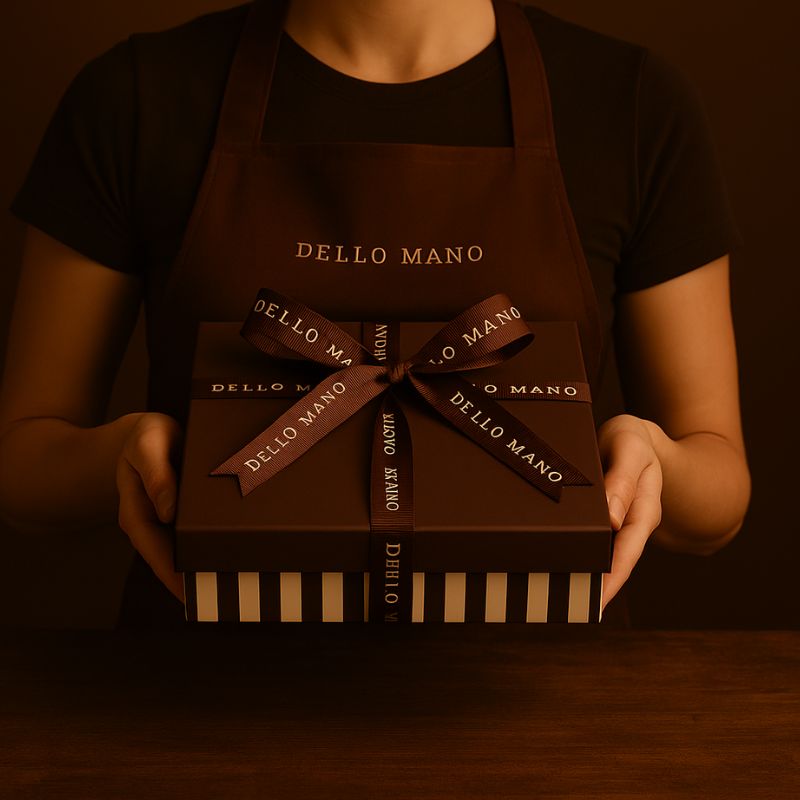
All imagery is created for Dello Mano. Our cakes and brownies are photographed and styled by our team, while some supporting scenes may be artistically generated or enhanced to reflect our handmade aesthetic. Each image is intended to represent the care, craft and calm that shape Dello Mano.

