
How Brownies Hold Their Texture During Delivery (And Why It Matters)
|
|
Time to read 12 min

|
|
Time to read 12 min
When baked goods are sent from one place to another, they don’t remain static. They are exposed to movement, changing temperatures, and time — all of which can affect how they look, feel, and taste when they arrive.
Understanding how brownie texture is maintained during delivery comes down to structure, formulation, and how those elements respond under real-world conditions. Not all brownies behave the same way. Some maintain their form and consistency, while others shift, dry out, or lose cohesion.
To understand the underlying structure behind this behaviour, you can explore what makes a brownie rich and fudgy →
This difference is not accidental — it is built into how the brownie is made.
Brownies hold their texture during delivery through a combination of structural density, chocolate-based formulation, and balanced moisture content. Their cohesive crumb resists movement and vibration during transport, while the presence of real chocolate and butter supports internal binding and stability. This creates a hybrid structure — not overly light, not overly soft — that allows the brownie to maintain its form even when exposed to typical delivery conditions.
During transit, brownies may soften slightly in warmer environments, but they do not typically lose their structural integrity. Unlike more fragile baked goods, a well-balanced brownie flexes rather than breaks. Once refrigerated after delivery, the fats within the brownie firm evenly, allowing the texture to stabilise and return to a consistent, sliceable state. This ability to recover after movement is a key part of how brownies perform reliably over distance.
Individually wrapped brownies are further protected from air exposure, friction, and moisture loss. This creates a controlled environment around each piece, helping preserve both surface and internal texture during transport. Combined with structured packaging, this approach supports consistency from dispatch through to arrival, allowing brownies to travel well across varying conditions while maintaining their intended texture and eating quality.
Delivery introduces a series of physical and environmental factors that impact baked goods:
These forces may seem minor, but over hours — or even days — they compound. Soft or fragile baked goods can shift, compress, or break down under these conditions.
For brownies, the key question is whether the internal structure can absorb these stresses without losing integrity.
If you're considering how brownies behave across distance, our Brownie Delivery Australia service is built around products designed to maintain their structure, consistency and presentation during transit.
Texture is not just a technical feature — it defines the eating experience.
A brownie that holds its texture:
When texture stability is lost, the experience changes:
For gifting or delivery, this matters even more. The expectation is that what arrives reflects what was intended — not something altered by the journey.
For a closer look at how different brownie styles vary in structure and texture, you can explore our Brownie Collection, where formulation plays a key role in how each piece performs.
At the core of texture stability is structure.
Brownies sit between two extremes:
Their ability to hold texture depends on:
A cohesive crumb means the internal structure stays connected rather than breaking apart.
Denser brownies tend to resist movement better than lighter, more aerated ones.
Ingredients must bind effectively so the brownie behaves as a unified whole rather than separate components.
This is where the idea of a hybrid structure becomes important — not too light, not overly soft, but balanced.
Chocolate plays a central role in how brownies behave during delivery.
Unlike cocoa powder alone, chocolate introduces:
Fat in chocolate helps:
This contributes to a brownie that is less likely to:
The result is a more stable structure that performs better over time and distance.
In practice, brownies made with high-quality chocolate — such as Belgian chocolate — tend to develop a more cohesive internal structure due to the balance of cocoa solids and cocoa butter. This contributes not only to flavour, but to how the brownie behaves during transport, allowing it to remain stable across a range of conditions without breaking down.
Texture stability is a balancing act between moisture and fat.
This balance is what allows brownies to move through delivery environments without significant change.
Not all brownies are designed for movement.
Common issues arise from:
These types may taste appealing initially but can struggle to maintain their form once exposed to delivery conditions.
One of the most overlooked aspects of brownie delivery is recovery.
After transit, brownies often:
Simple steps can support this:
This process helps restore:
Brownies with a well-balanced structure tend to recover more effectively than those without.
Brownies that are individually wrapped tend to recover particularly well after delivery. When each piece is protected, external conditions have less direct impact on the surface and internal structure. In some cases, brownies stored in the fridge after arrival will firm up evenly, allowing the texture to settle into a more cohesive state before returning to room temperature for serving.
Unlike traditional chocolate, which may melt or develop bloom when exposed to fluctuating temperatures, brownies with a chocolate-led formulation tend to respond differently. Their structure allows them to withstand warmer conditions during transit and then stabilise again once cooled, reducing the risk of visual or textural degradation.
Texture stability is not just about the journey — it is about performance beyond day one.
A well-formulated brownie:
This contributes to:
For delivery, this consistency is critical. It ensures the product remains reliable regardless of timing.
Brownies made with a higher proportion of real chocolate and butter often behave differently from typical bakery-style recipes. Their structure sits somewhere between a baked product and a chocolate confection, allowing for a longer and more stable shelf life when stored correctly. When refrigerated on arrival, this type of formulation can maintain quality over extended periods, often lasting weeks rather than days.
During delivery, one of the most influential variables is temperature.
Unlike controlled kitchen conditions, transport environments can shift significantly — from warm delivery vans to cooler indoor holding areas. These changes affect how fats and moisture behave within the brownie.
When temperatures rise:
When temperatures drop:
This natural response is not necessarily a flaw — it is part of how brownies behave as a chocolate-based product.
What matters is how well the structure adapts.
Brownies with balanced formulation tend to:
This is where chocolate plays an important role again. Its fat composition allows brownies to move between soft and firm states without losing integrity.
In contrast, less stable baked goods may:
Understanding this behaviour helps explain why some brownies arrive in excellent condition despite varying delivery environments.
Beyond formulation, the physical format of a brownie also influences how well it holds its texture.
Brownies that are:
tend to perform more reliably during delivery.
Smaller, uniform portions:
This is particularly important when multiple pieces are packed together. If sizes are inconsistent, larger or softer pieces may compress smaller ones, affecting overall presentation and texture.
Individual wrapping can also contribute to stability:
These factors work together to support a more controlled delivery outcome.
While often overlooked, portioning and format are practical elements that influence how brownies behave outside the kitchen.
Time is another variable that quietly shapes brownie texture during delivery.
From the moment a brownie is baked, its structure continues to evolve.
Over time:
This process can actually benefit brownies, particularly those designed with a balanced structure.
During delivery, this means that rather than degrading, some brownies:
However, this depends heavily on formulation.
Brownies that are too dry may continue to lose moisture.
Brownies that are too soft may not stabilise effectively.
Well-balanced brownies, on the other hand, tend to reach a point where:
This makes them particularly suited to delivery, where time is always part of the journey.
In real-world conditions, brownies are often exposed to long distances, multiple handling points, and varying climates. They may travel across cities, interstate, or internationally, moving through environments that range from controlled interiors to warmer transit conditions. Observationally, brownies with a balanced, chocolate-led structure tend to maintain their integrity more consistently across these journeys, even when exposed to less predictable conditions.
In some cases, brownies have been transported across continents — from Australia to locations such as North America, Africa and parts of Asia — arriving with their structure intact. This type of performance highlights the importance of formulation and structure when baked goods are expected to travel beyond local delivery conditions.
Brownies may travel across cities, between states, and through multiple handling points, experiencing repeated movement, changing environments, and delays along the way.
During this time, they experience:
Observationally, brownies with:
tend to maintain their texture more consistently across these scenarios.
This is not about perfection — it is about reliability. This type of performance reflects formulations developed specifically for real-world delivery conditions rather than immediate consumption alone.
Texture stability is not only about formulation — packaging plays a supporting role.
When brownies are individually wrapped, each piece is protected from direct exposure to air and movement. This helps:
Layered packaging — such as tissue-lined boxes and structured outer cartons — further reduces movement during transit and contributes to a more controlled environment inside the box.
While often seen as part of presentation, packaging is also a functional element that supports texture consistency from dispatch to delivery.
When sending brownies, texture stability directly affects:
A brownie that arrives intact and consistent:
This becomes especially important when the sender is not present — the product must carry that moment on its own.
When brownies are sent across Australia, their ability to maintain structure and texture becomes critical to ensuring a consistent and reliable delivery experience.
Delivery environments are never perfectly controlled.
Because of this, the goal is not perfection — it is consistency.
A well-structured brownie:
This consistency ensures that even after transit, the brownie still delivers:
If you’re looking to understand different brownie styles and formats, you can explore our Brownie Collection to see how variations in formulation influence texture and structure.
For practical guidance on sending brownies, including delivery options and formats, visit our Send Brownies Australia page.
In most cases, brownies do not undergo permanent structural change during delivery — they experience temporary shifts due to movement and temperature variation.
A well-formulated brownie with balanced fat and moisture will flex slightly during transit, particularly in warmer conditions, but its internal cohesion remains intact. Once allowed to rest — especially when refrigerated — the structure stabilises again and returns to its intended texture.
Permanent structural breakdown typically only occurs in brownies that are either too dry (leading to crumbling) or too soft (leading to collapse).
Chocolate-led brownies benefit from the presence of cocoa butter, which contributes both fat and structural cohesion.
Unlike cocoa-only formulations, chocolate introduces a more stable internal matrix. This allows the brownie to:
This is particularly important during delivery, where temperature fluctuations can soften or firm the product. Chocolate-based structures adapt to these changes more effectively than lighter, flour-forward baked goods.
Individual foil wrapping creates a controlled micro-environment around each brownie.
This helps to:
It also protects the surface of the brownie, preserving both texture and appearance.
From a structural perspective, this means each piece behaves independently rather than being affected by pressure or movement from surrounding items — resulting in more consistent texture on arrival.
While brownies contain chocolate, they are not pure chocolate — their structure includes other ingredients that stabilise the overall matrix.
This means that even when exposed to warmer conditions:
Once cooled, brownies return to a stable state without the visual or textural inconsistencies often associated with temperature-sensitive confectionery.
Refrigeration acts as a stabilisation step rather than a preservation-only step.
When brownies are placed in the fridge after delivery:
This allows the brownie to reset into a cohesive, sliceable form.
Returning the brownie to room temperature before serving then restores its intended eating texture — soft, dense, and balanced — without compromising structure.
Formulation determines whether a brownie continues to perform well beyond the day it is baked.
A balanced, chocolate-led brownie tends to:
This creates a product that is not only suitable for delivery, but also reliable over several days or weeks when stored correctly.
In contrast, less stable formulations may degrade quickly — becoming dry, crumbly, or structurally inconsistent.
In some cases, yes.
As brownies rest, particularly under refrigeration, their internal structure can become more uniform. Moisture redistributes, and the crumb settles into a more cohesive form.
This can result in:
This effect is most noticeable in brownies designed with a balanced fat and moisture profile.
When properly formulated and packaged, brownies can perform consistently across long distances and varied climates.
Their success in these conditions depends on:
Brownies that combine these elements are able to withstand extended transit times and temperature variation while maintaining their texture and integrity on arrival.
By Those Who Know Luxury






Deborah Peralta
About the Author
Deborah is a food scientist and marketing professional with a background in new product development, brand management and new business development for major food brands. She co-founded Dello Mano with Bien in Brisbane in 2006 and has spent 20 years developing handmade brownies, cakes and other foods through the business. Her work combines practical food knowledge, product development experience and the day-to-day realities of building an independent food brand.
Explore Cakes and Gifts
Browse our handmade cakes, brownies and gifts for birthdays, celebrations and thoughtful giving.

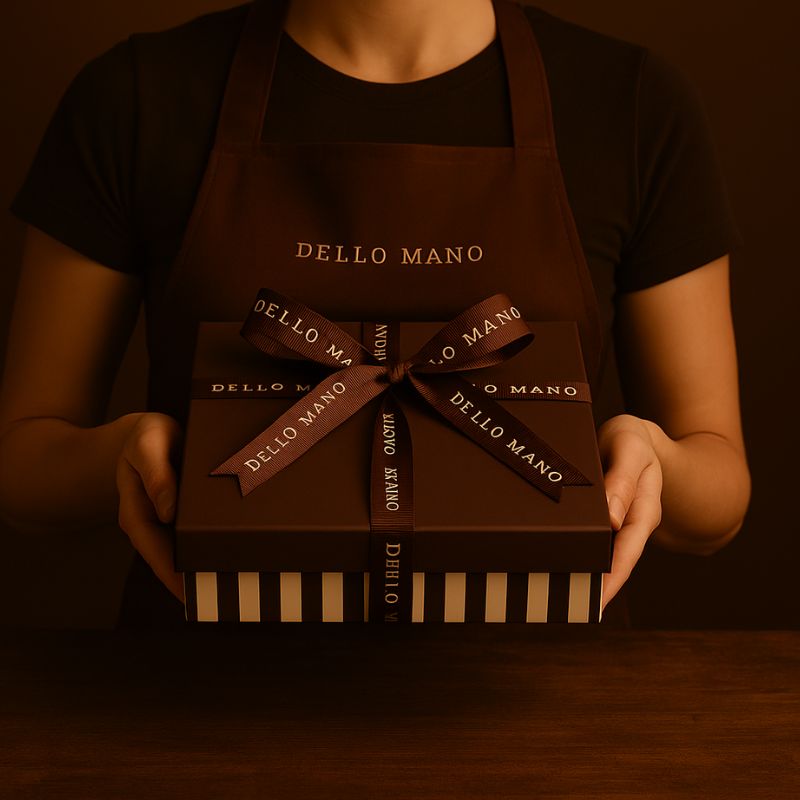

Imagery Note
All imagery is created for Dello Mano. Our cakes and brownies are photographed and styled by our team, while some supporting scenes may be artistically generated or enhanced to reflect our handmade aesthetic. Each image is intended to represent the care, craft and calm that shape Dello Mano.

